• City Greens and the Pursuit of Freshness

    KingfishWindow

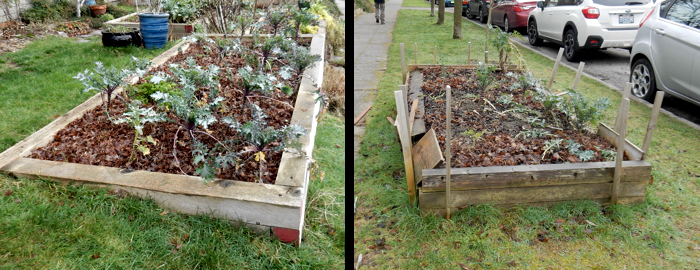
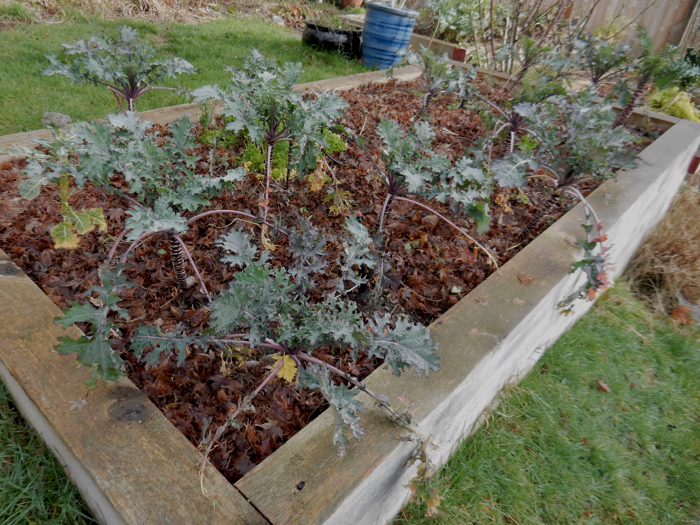
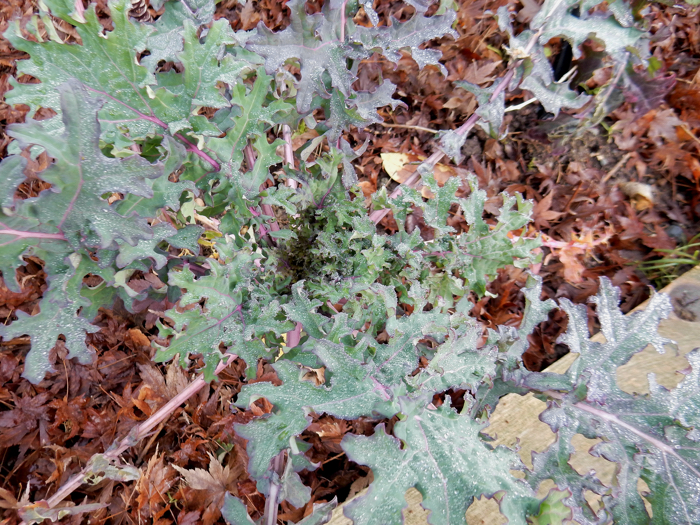
    You don’t have to live in the country on acreage to enjoy fresh greens. It doesn’t take a lot of space to grow vegetables. We were in Seattle yesterday to enjoy one last meal at The Kingfish Cafe with a friend before the cafe closes this coming Sunday, January 25, 2015. On our way to the cafe, we walked by a series of raised vegetable beds in a yard and on a parking strip.

    Whoever lived in that house, had a steady supply of kale through the winter. Twenty to forty kale plants, can supply a family with fresh greens all winter long. You can’t beat freshly picked greens.
    CityVegetablesA
    CityVegetablesB
    CityVegetablesC

    I often wonder why it is that freshness is not a high priority in the USA. It’s a mystery. I saw a clip on Japanese news yesterday about strawberries. Strawberries are an important winter fruit in Japan, and different regions compete to produce the sweetest, largest berries. The clip was about a new variety of strawberry called Skyberry produced in Tochigi. Growers of this variety of strawberry are wanting to export them to France, but were running into a serious problem. Within Japan, they can get their berries into stores within two days of picking. But when they ship them to France, it takes four days from picking until they are on store shelves. And for the strawberry growers, this was a major concern, as strawberries are fragile, and if they are bruised at all during shipment, they will no longer be salable after four days.
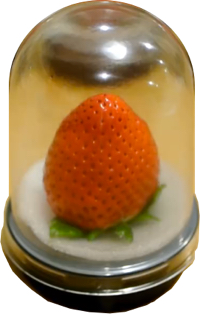
    FreshellWatching the news clip, I wondered if US growers of strawberries gnashed their teeth at the thought of it taking more than two days to get their strawberries onto store shelves. To deliver these Skyberry strawberries to France without damaging them, an agricultural research company developed special packaging which envelopes each strawberry in a protective shell they call a freshell. None of this is cheap. Each freshell costs $2 and the Skyberries will sell for $12 to $14 each in France. In Japan they retail for around $20 a pound. A luxury item for sure, but I wonder why freshness is sought after in Japan and is barely an afterthought in the USA.

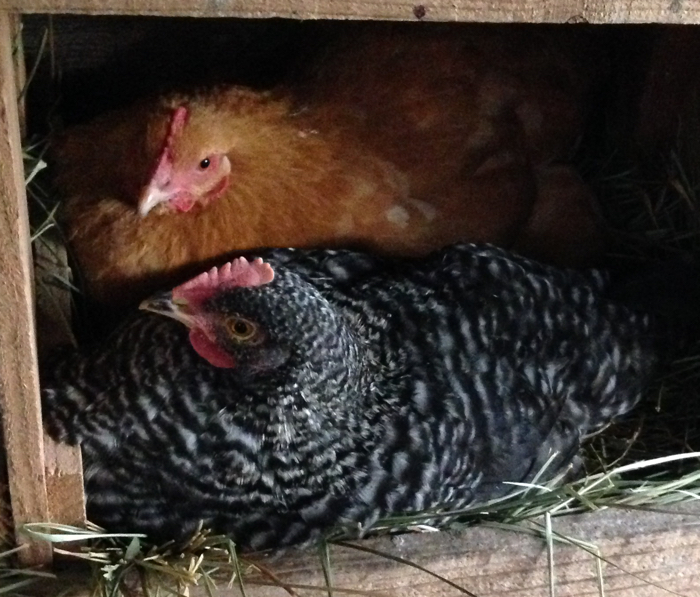
    Home, after a wonderful meal and company, I found mother and daughter in a nest when I went to collect eggs. A few more months, and if the daughter insists on staying with her mother, the two will be laying eggs together.

    EggLayingWithMother

  • Just Ask

    JustAskA

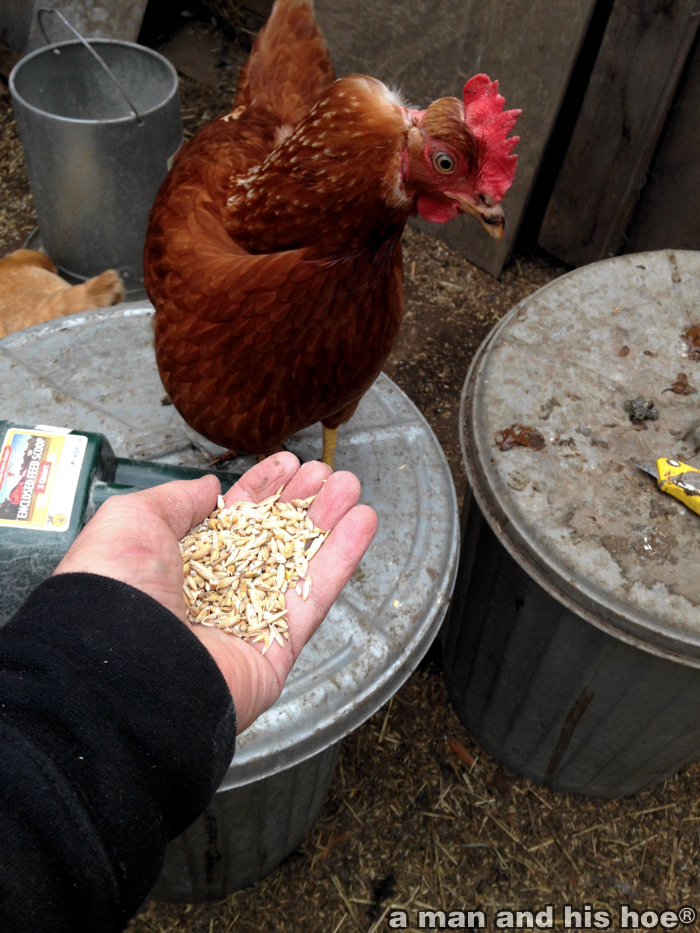
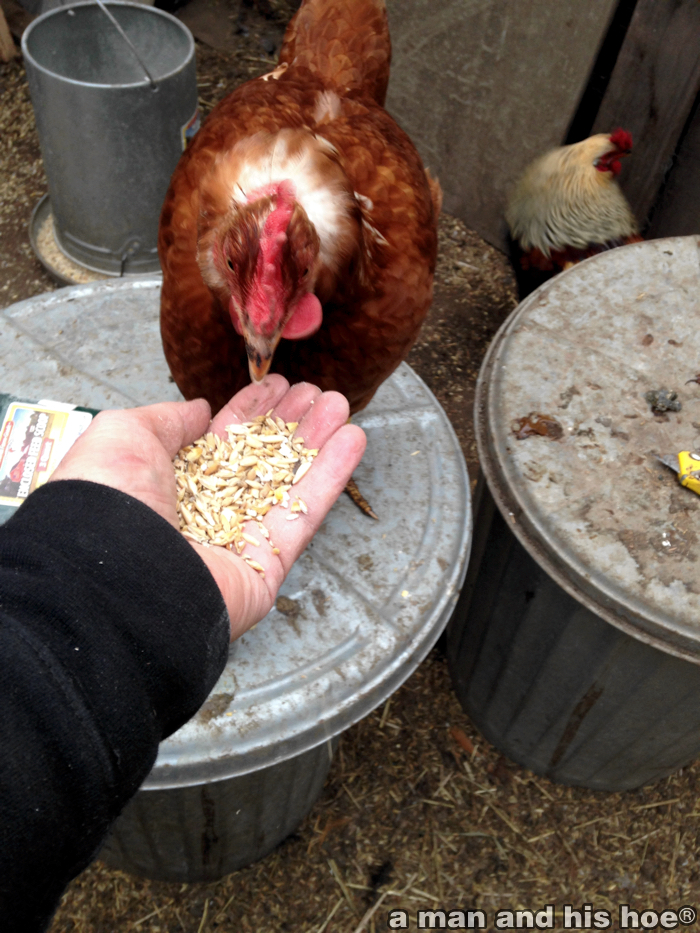
    Some of the chickens, Lucky especially, aren’t as shy as I am. If she wants something, she doesn’t hesitate to ask. This afternoon, she wanted her supper hand carried to her. After raising a clutch of well adjusted chicks this fall, she deserves special treatment.

    Each chicken’s comb is as unique as a fingerprint. If you look at Lucky’s comb, you’ll see one tooth with two points that sticks out further than the others. There is an infinite variety of combs. Some have many teeth, others just a few. Some flop to the left, some to the right, some are rigid, some are short, and some are flat. There are combs with very deep valleys, tall ones, and short ones. One of the easiest ways to tell chickens apart, is by their combs. When the chickens are in tall grass, and all you can see are their combs, you can still tell who they are by their combs.

    Another way to tell them apart is by their voice. Chickens’ voices are as distinct as human voices. Did you know that?

    JustAskB

  • More Signs of Spring

    EarlySpringB

    With the unseasonably warm weather and increasing length of the days, it’s impossible to step outside and not see new signs of spring each day. Daffodils are popping up and sweet daphne buds are bulging. It feels more like mid-February than January.

    EarlySpringA

    It’s a contrast from past Januaries, like January 2007 and 2012. The chickens don’t care much for the snow. They will put up with it, but the boys dream about days when the snow falls thick and fluffy. The deeper the snow, the more fun they have.

    Winter2007
    Winter2012

  • The Law of Beauty

    DyingTree1

    Deep in the woods, an alder has died. The mushrooms and mosses and ferns have moved in and are devouring it. But, even as they slowly turn the tree into dirt, they assiduously follow the law of beauty, one of nature’s preeminent principals. There’s Amalie Noether’s theorem, a fundamental tool of modern theoretical physics and the calculus of variations, which states that any differentiable symmetry of the action of a physical system has a corresponding conservation law. There are Newton’s laws of motion. There are the Einstein field equations, which describe the curvature of space-time due to mass-energy equivalent to the gravitational field. And on and on and on.

    Then there is the law of beauty, Nature’s dictum that whatever must be done must be done with beauty. The mosses and mushrooms and ferns flagrant display of beauty, as they perform the mundane task of dismembering the dead alder, illustrates this fundamental law of Nature. You could say that Nature has an addiction to beauty. The capitalists and industrialists and hedge fund managers which rule us are doing their utmost to make sure we never see this beauty. They are working feverishly to wipe out as much of nature’s beauty as possible. They’ve even gone so far as to turn on as many lights as possible at night, so that we can’t see the glorious stars and planets and milky way and other galaxies when the sun sets. Their insidiousness knows no bounds.

    All it takes is an alder dying in the woods to take heart that in some places at least, Nature’s law of beauty still prevails.

    DyingTree2
    DyingTree3
    DyingTree4

  • The Delicious Warmth of Eggs

    WarmEggs

    What no one prepared me for was how warm fresh eggs are. The first time I picked up a just laid egg, what charmed me most was how warm it was. The internal temperature of a hen is between 105º and 113ºF (41º to 45ºC). Compared to a human’s body temperature, it’s like a steam bath. Eggs come out steaming. You can see the moistness steam off them before the hen sits back down, and in seconds, they are dry to the touch. Hens sit while they wait for their eggs to roll out of them. But just before they lay them, they stand up, close their eyes, take some deep breaths, and push the eggs out of their cloaca. Is it painful? I don’t know. There is some visible stress, but it is nothing like twelve hours or more of hard labor. The warm egg falls into the nest and dries by the time the hen sits down.

    When I go collect eggs, I’ll frequently find a nest with four or five fresh eggs, with the last hen having left the nest just moments ago. Having been kept warm with hen after hen sitting on the same nest, when I reach for the eggs, the whole nest is toasty, with the last egg the warmest of all.

    This is just between you and me, but one of the most delicious things in the whole world is a super fresh, still warm, raw egg. The warm, buttery yolk of such an egg has so much flavor. They are good alone, or one top of hot rice with a few drops of soy sauce.